
KINJI FUKASAKU SPECIAL and BACK BY POPULAR DEMAND
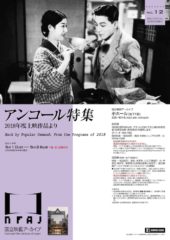
3 Gangsters, a Prostitute and a Wife
Venue(s): National Film Archive of JapanDate: April 23 (Tue) – May 26 (Sun), 2019, Check on the theater site.
Language: Japanese with English subtitles
Official website: www.nfaj.go.jp/english/visit/information_map/#section1-4
Theater website: www.nfaj.go.jp/english/exhibition/
Theater website: www.nfaj.go.jp/english/exhibition/fukasaku201903/
Theater website: www.nfaj.go.jp/english/exhibition/encore201903/
Tariff: General: ¥520, Student/Senior: ¥310
Advance tickets: ¥520+¥108, http://bit.ly/2DbGued
Title: 映画監督 深作欣二、アンコール特集 (Eiga Kantoku Fukasaku Kinji, Encore Tokushu)
The National Film Archive of Japan is paying tribute to that legendary director of gangster films, Kinji Fukasaku, this spring. It is also replaying several popular titles in a Back By Popular Demand section — so you have three English-subbed choices, each of them painting a portrait of Japan that none of us has ever known.
Many critics consider Fukusaku's sixth film, Wolves, Pigs and Men, to be his breakthrough. He had churned out hardboiled work for Toei that mimicked the style of a successful series by rival studio Nikkatsu, but with this blood-soaked yakuza masterpiece, he began incorporating commentary on Japan’s postwar social problems and found his own, singular voice.
Wolves, Pigs and Men, 95min, 35mm, black and white, English subs, 1964, Japan
Director: Kinji Fukasaku
April 25 (Thu), 2019 1:00 PM, Nagase Memorial Hall Ozu
May 5 (Sun), 2019 4:30 PM, Nagase Memorial Hall Ozu
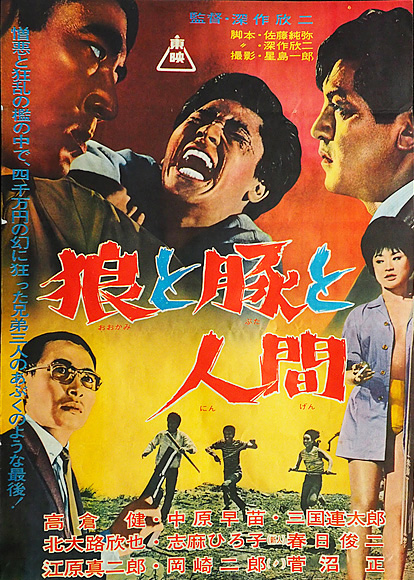
As historian Jasper Sharp has written, “Wolves, Pigs and Men… established Fukasaku's pattern for contemporary action and crime dramas inspired by the French New Wave and American noir, featuring realistic portrayals of violence and often set in chaotic, working-class milieux.”
The film features three of the 20thcentury’s most iconic actors, Ken Takakura, Rentaro Mikuni and Kin'ya Kitaoji, as brothers who grow up in the slums of Tokyo, become gangsters and engage in all manner of dirty, double-crossing dealings to survive — as well as to undermine each other. The air of hopelessness is pervasive, and the nastiness is increasingly ferocious.
Fukasaku shot in black-and-white Tohoscope widescreen, and he makes amazing use of its grittiness. The film features what would become trademark visual flourishes and is driven by a thrilling jazzy soundtrack byIsao Tomita.
Wife! Be Like a Rose, 74min, 35mm, black and white, English subs, 1935, Japan
Director: Mikio Naruse
May 11 (Sat), 2019 1:45 PM, B1 Theatre
May 26 (Sun), 2019 11:00 AM, B1 Theatre

Mikio Naruse’s 1935 Wife! Be Like a Rose is being screened with English subs. Enduringly popular, the comical melodrama was the first-ever Japanese film to be shown in commercial screenings in the US, and has continued to be in demand.
Despite the title, the story is told from the point of view of a modern young lass named Kimiko (Sachiko Chiba), who’s in a quandary because she cannot get married to Keiji (Heihachiro Okawa) unless her father (Sadao Maruyama) makes the expected arrangements with the groom’s family. Unfortunately for the young lovers, Kimiko’s parents have not lived together for some 15 years, and dad is currently shacked up with a geisha (Yuriko Hanabusa) and their two children. But for Kimiko’s sake, he agrees to return and give his marriage to her mother (Tomoko Ito) one more try. But this domestic arrangement, predictably, proves untenable…
Although Kimiko and Keiji’s relationship feels almost contemporary at times, Kimiko says of her mother, “Men like a wife who acts childish and cajoling, or jealous sometimes, or motherly and protective. But my mother can’t do it. Not that she doesn’t know; she knows but she can’t.” Naruse presents a compelling argument for the legitimacy of true love and second families, but he makes sure that Kimiko preserves the status quo, reassuring audiences, “I know I’ll make a good wife.”
Wife! Be Like a Rose is playing with an 11-minute silent 8mm film, Flower viewing trip Studio F, made around the same time, featuring Naruse with his Studio F cofounders, Heinosuke Gosho and Masumi Fujimoto, at a hanamiparty in Saitama with Gosho. They’re joined by actors Sachiko Chiba, Setsuko Shinobu, Ikuji Kobayashi and Sotaro Kawakita.
Takekurabe, 95min, 35mm, black and white, English subs, 1955, Japan
Director: Heinosuke Gosho
May 17 (Fri), 2019 4:30 PM, B1 Theatre
May 26 (Sun), 2019 2:30 PM, B1 Theatre

Takekurabe (variously known in English as Adolescence, Growing Up Twice, Growing Up, and Child's Play) is a black-and-white film directed by Heinosuke Gosho, adapted from the 1896 novella of the same name by Higuchi Ichiyo, one of Japan's most prominent female authors of the Meiji period.
It tells a story of star-crossed young love, and is set not in the typical countryside, but rather on the edge of the Meiji-era Yoshiwara red-light district of Tokyo. Midori (singing-acting icon Hibari Misora) is a young woman who falls in love with Shinnyo (Takashi Kitahara), an acolyte at the nearby temple, and they share a budding relationship before she must follow in the family footsteps, and start working at one of the Yoshiwara brothels.
National Film Archive of Japan
Please be sure to check with the theater before going.