
NFAJ: Women Who Made Cinema
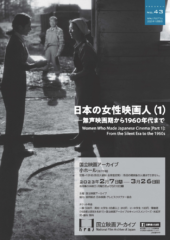
Female Filmmakers Get Their Due
Venue(s): National Film Archive of JapanFebruary 7 - March 26, 2023
Language: 3 films are with English subtitles
Official website: www.nfaj.go.jp/exhibition/women202212/#section1-2
Theater website: www.nfaj.go.jp/english/visit/access/
Theater website: www.nfaj.go.jp/english/exhibition/women202212/
Theater website: www.nfaj.go.jp/english/
Tariff: General: ¥520, Student/Senior: ¥310, Under 16: ¥100
Advance tickets: Find "チケット購入" on the schedule. https://www.nfaj.go.jp/exhibition/women202212/#section1-3
Title: 日本の女性映画人(1) (Nippon no Josei Eigajin (1))
The National Film Archive of Japan (NFAJ) is starting off the year right, with a two-part celebration of Women Who Made Japanese Cinema. Part 1, covering the silent era to the 1960s, runs from February 7 – March 26, and is filled with rare goodies.
Among the 81 films and documentaries being shown, three of the works have English subtitles, while others are silent and don’t require them. Here’s your chance to dip a toe into this exciting showcase for the talents of Japan’s female filmmakers, from scriptwriters like Yoshiko Hayashi, Ayame Mizushima, Kikue Sha, Yoko Mizuki and Sumie Tanaka, to directors like Noriko Suzuki and actress-turned-directors Kinuyo Tanaka and Yuko Mochizuki. Also featured are works by producer Takiko Mizue, editor Yoshi Sugihara, art director Shinobu Muraki and costume designers Hanae Mori and Etsuko Yagyu, among many others.
OSAKA ELEGY, 浪華悲歌
February 21, 2023 (Wed) 15:00
February 23, 2023 (Thur) 16:00
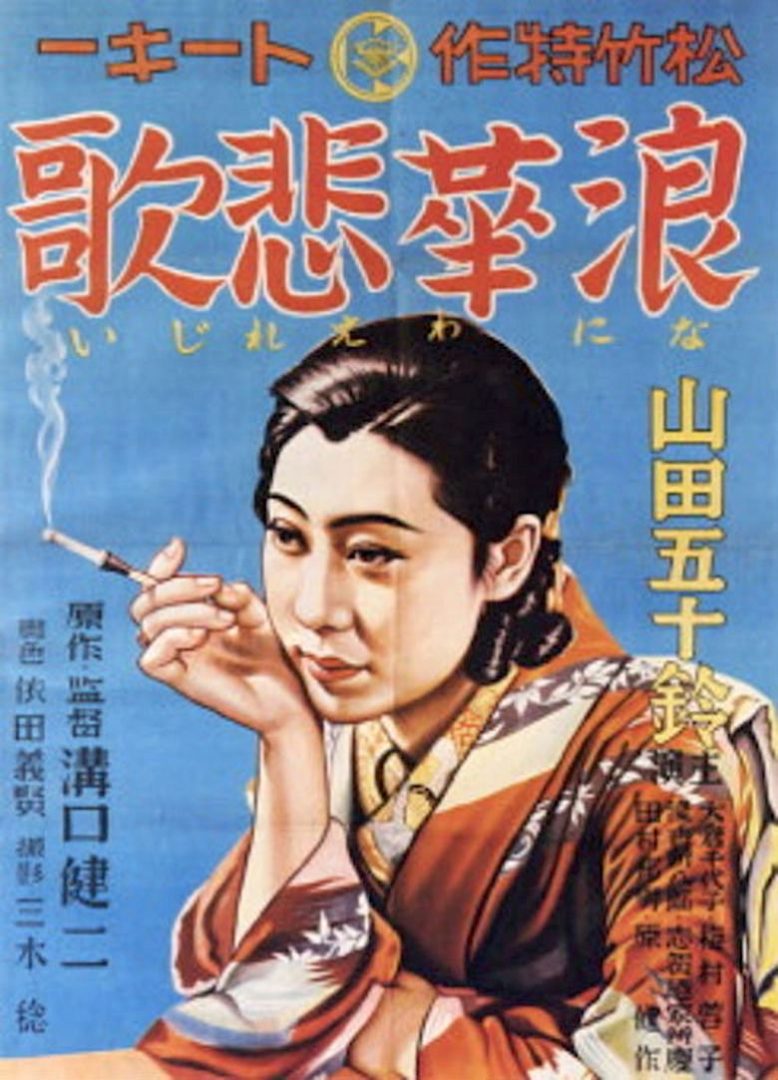
Osaka Elegy, 浪華悲歌
1936, 72min, 35mm, B&W, with English subtitles
Although best known for establishing Kenji Mizoguchi as one of Japan’s major directors, this film is included in NFAJ’s survey because it was edited by Tazuko Sakane, whose career began in 1930 when she was hired as Mizoguchi’s assistant. By the time Osaka Elegy was released in 1936, she had worked on virtually all stages of film production, and assisted Mizoguchi on more than 10 films as assistant director, screenwriter and editor.
In the same year, Sakane also became Japan's first female director, with the release of New Year’s Finery (1936). She remained the only female director active in Japan (and, during the war, in Manchuria) until 1953, when the actress-turned-director Kinuyo Tanaka made her first film. Sakane’s career continued to encompass a vast variety of projects until her retirement in 1962.
Osaka Elegy immediately established Mizoguchi as a master of the melodrama. It also marked the first of many films featuring the theme of a woman’s downward spiral, as she is spurned by the men she tries to help and cast into an unforgiving world. Isuzu Yamada stars as Ayako, a switchboard operator who is forced to help support her useless father, an embezzler, by taking up with her former boss at the Asai Drug Company. When that debt is paid off, she must next assist her brother with his tuition fees, and turns to a new admirer for help. When her former fiancé spurns her in front of the police, she is forced to return home. Naturally, as a fallen woman, she can expect no help from her father or her brother.
BRIDES OF THE FRONTIER, 開拓の花嫁
February 21, 2023 (Wed) 15:00
February 23, 2023 (Thur) 16:00
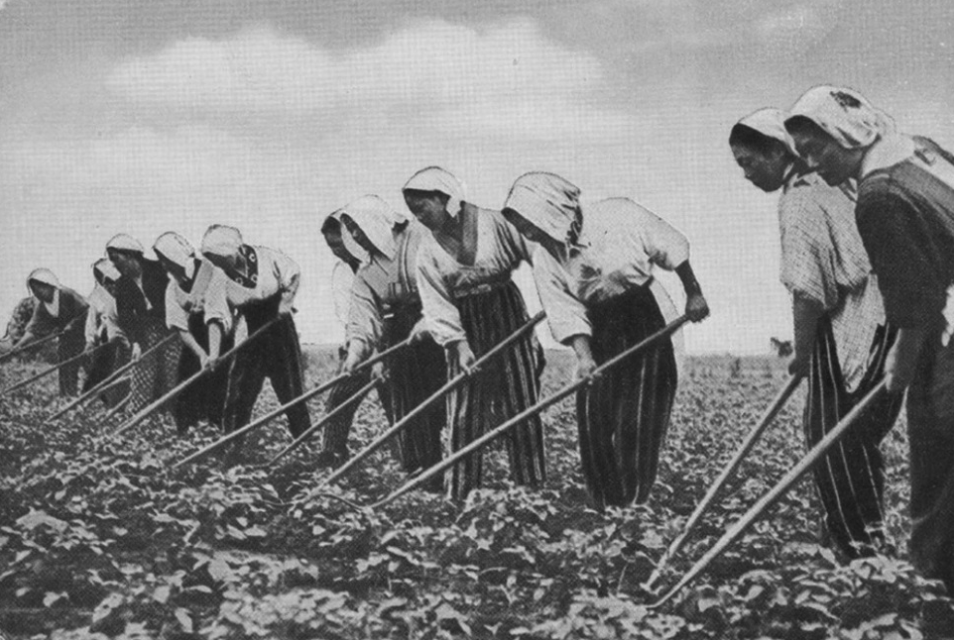 Image only, not from the film.
BRIDES OF THE FRONTIER, 開拓の花嫁
1943, 21 min, 35mm, B&W, no English subtitles
Although it is not being shown with subtitles, if you’re curious about Sakane and want to see something she’s written and directed, don’t miss her 1943 The Pioneer Bride, a propaganda film produced by the Manchu Film Association (Man-ei) to promote Japan’s Manchurian immigration project during WWII — by recruiting single women back home to make up for the shortage of wives. It is the only work by Sakane known to have survived, and was discovered in the 1960s in Aomori Prefecture.
GATE OF HELL, 地獄門
March 14 (Tue), 2023: 15:00
March 25 (Sat), 2023: 16:20
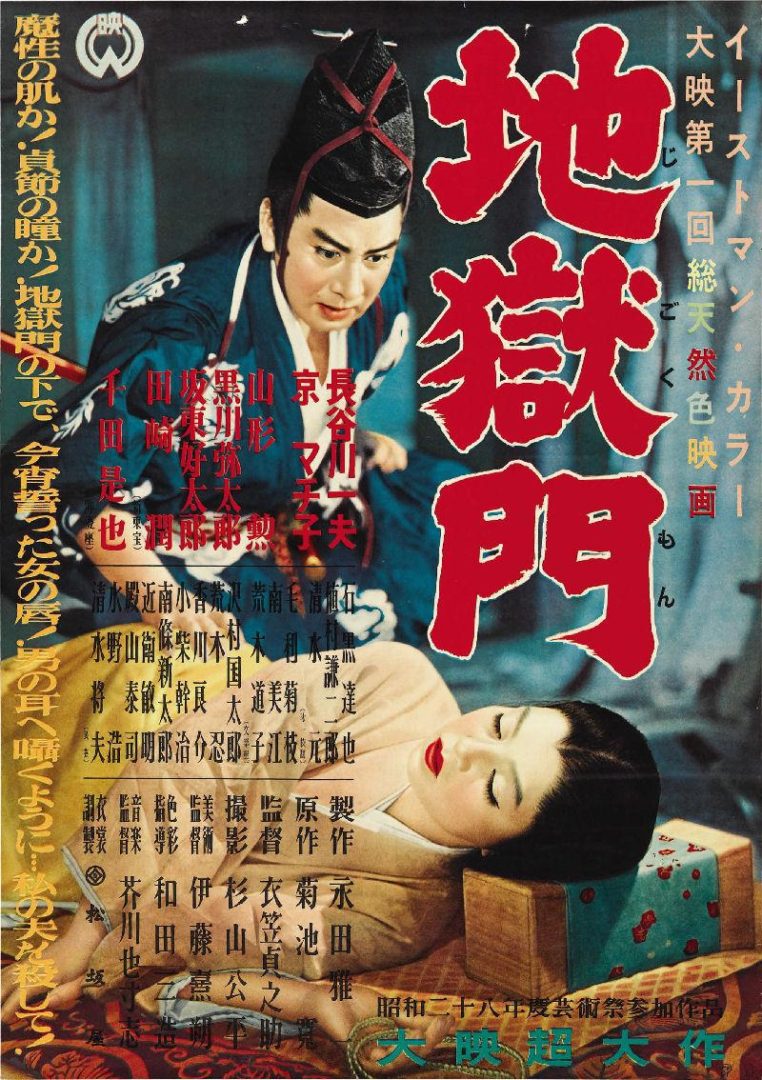
Gate of Hell, 地獄門
1947, 89 min, 35mm, Color,
Digitally restored, with English subtitles
Miyoko Akiyama joined Daiei Kyoto in 1947 and worked on many of Teinosuke Kinugasa's films as a script supervisor before moving to Nikkatsu, which had resumed production in 1954. Very little is known about her, but NFAJ is recognizing her contributions to Kinugasa films with screenings of the sumptuous period drama Gate of Hell (1953).
The film was one of the key works of the early 1950s to first reach foreign markets, with such spectacular color cinematography that it won the Grand Prix at Cannes, Academy Awards for Best Foreign Language Film and Costume Design, and has since been named by Martin Scorsese as one of the 10 greatest color achievements in world cinema.
Gate of Hell takes place in the 12th century, when samurai warrior Morito (Kazuo Hasegawa) thwarts a palace rebellion and saves the life of the empress, using Lady Kesa (Machiko Kyo) as a decoy. When Morito is offered anything he desires as a reward, he requests Kesa’s hand in marriage. Informed that she is already married to a fellow samurai (Isao Yamagata), he refuses to withdraw his request, and a tragic chain of events is set into motion.
A HOUSE OF SHAME, 五番町夕霧楼
March 19 (Sun), 2023: 15:50
March 24 (Fri), 2023: 15:30
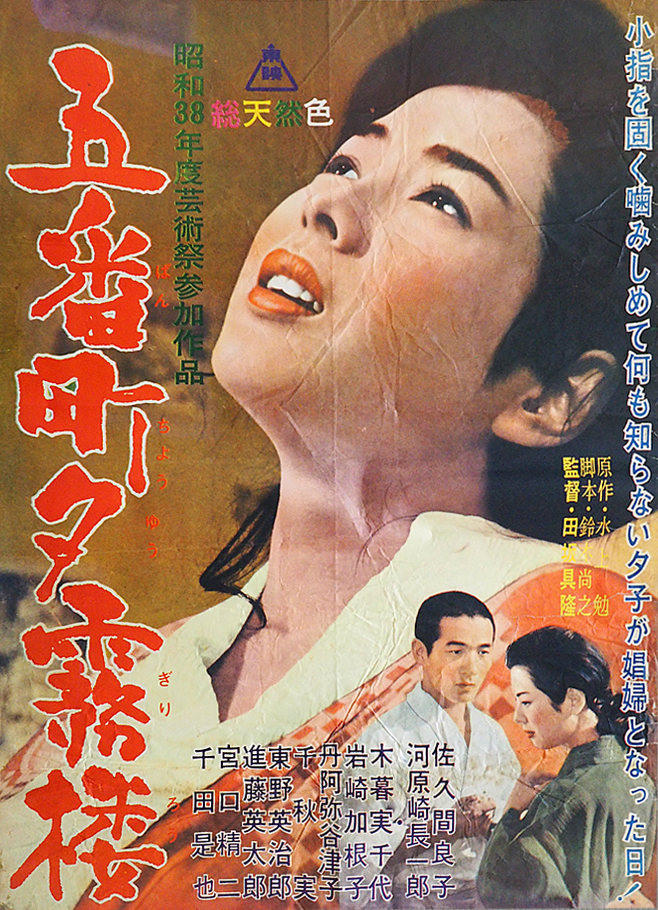 A House of Shame, 五番町夕霧楼
1963, 137 min, 35mm, Color, with English subtitles
Reiko Takaiwa (née Sasaki) became a full-fledged script supervisor at the Toei Tokyo Studios with Tomotaka Tasaka’s A House of Shame (1963), and later worked on many films by Teruo Ishii (Abashiri Prison series), Shinji Murayama and others.
Set in Kyoto in 1950 and based on Tsutomu Mizukami's novel of the same name, A House of Shame tells the story of a beautiful young woman, Yuko (Yoshiko Sakuma), who’s sold by her father to a brothel so she can help her poor family in a fishing village. She soon falls in love with a stammering novice monk at Kinkakuji, Kyoto’s beautiful golden temple. The two dream of returning to their hometown and getting married. But then the novice sets fire to the golden pavilion…
National Film Archive of Japan
Please be sure to check with the theater before going.