
THE YOUTH OF JAPANESE CINEMA
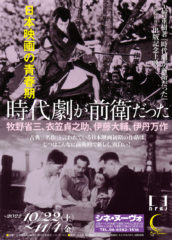
Rediscovering Kyoto Cinema’s Innovators
Venue(s): Cine Nouveau (Osaka)Crossroads: October 23 (Sun) and November 3 (Fri), 2022.
Language: Jujiro is with English intertitles.
Official website: www.cinenouveau.com/sakuhin/jidaigeki/jidaigeki.html
Theater website: www.cinenouveau.com/access/access.html
Tariff: Adults: ¥1,500, Senior: ¥1,200, Students: ¥1,100
Title: 時代劇が前衛だった/牧野省三、衣笠貞之助、伊藤大輔、伊丹万作 (Jidaigeki ga Zenei datta/Shozo Makino, Teinosuke Kinugasa, Daisuke Ito, Mansaku Itami)
Commemorating the publication of film historian Shigeki Koga’s new book, "Jidai-geki ga avant-garde ga araku: Shozo Makino, Tienosuke Kinugasa, Daisuke Ito, Mansaku Itami, Sadao Yamanaka” (When Period Dramas Were the Avant-Garde/The Youth of Japanese Cinema: Shozo Makino, Teinosuke Kinugasa, Daisuke Ito, Mansaku Itami, Sadao Yamanaka), Osaka’s historic Cine Nouveau is showcasing a lineup of 13 films that Koga highlights in his writing, including one with English intertitles: Tenosuke Kinugasa’s Crossroads (1928). If you happen to be in the area, be sure to drop by.
Koga’s book discusses how and why the films made in Kyoto from the early years of the 20th century through the 1930s were so innovative, focusing on the five filmmakers of the title and based on newly discovered films, documents, and testimonies of those who lived during the period. “In compiling this book,” Koga writes, “I realized that this story is unmistakably a coming-of-age ensemble piece. The characters were young, bold, and ambitious. Their youth, audacity, and ambition are all reflected in their films. So, first of all, I would like you to look closely at the screen. Their films are filled with a spirit of experimentation and adventure that would astonish even today's young independent filmmakers.
“The avant-garde city of Kyoto is the cradle of Japanese cinema. Katsutaro Inahata previewed the first cinematograph there, and Shozo Makino shot the first dramatic film, Honnoji Kassen. Studios opened up one after another, and the Great Kanto Earthquake attracted many talented people [who left after the Tokyo area’s destruction in 1923]. The energy and experimental spirit of the diverse filmmakers who gathered in Kyoto in the mid-1920s opened up new horizons for Japanese cinema, leading to the golden age of the 1930s. It was truly a time of youth for Japanese cinema.”
Crossroads (1928)
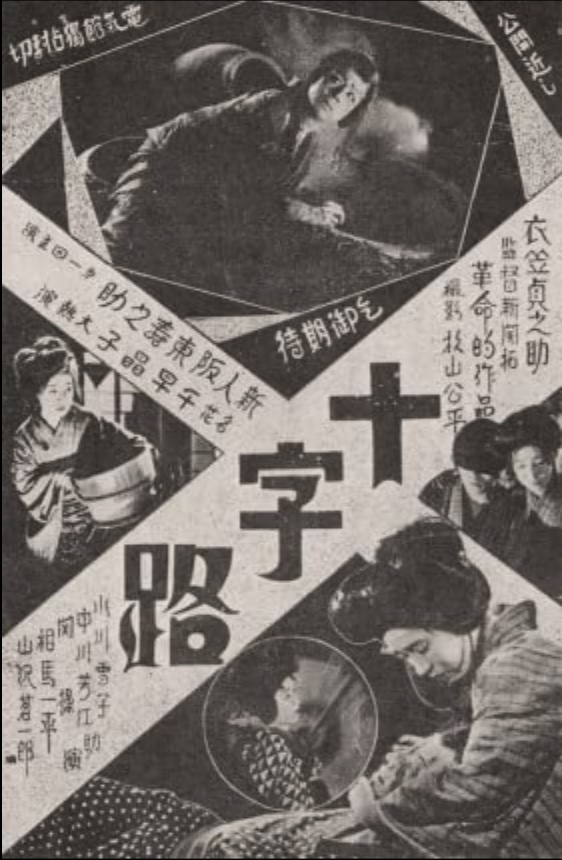
Crossroads/十字路
1928|Japan|65min
Director: Teinosuke Kinugasa (衣笠貞之助)
Kinugasa’s Crossroads (1928) was one of the first Japanese films to be shown in Europe and also screened in the US (as Slums of Tokyo), winning acclaim for its German expressionistic techniques (Kinugasa’s 1926 A Page of Madness is the masterpiece that endures today). It tells the story of a young man who is obsessed with a courtesan, and during a fight over her, seems to kill his rival as well as to be blinded himself. His sister, with whom he shares an apartment, is then tricked by a succession of men who claim to be able to help clear/cure her brother — but only for hefty fees. The sister debases herself to earn the money, and even greater tragedy then ensues.
Koga will appear at a talk show (Japanese only) and there will be a screening with a live piano performance by musician Ryo Torikai. For details, please check the theater’s official website.
Cine Nouveau
Commemorating the publication of film historian Shigeki Koga’s new book, "Jidai-geki ga avant-garde ga araku: Shozo Makino, Tienosuke Kinugasa, Daisuke Ito, Mansaku Itami, Sadao Yamanaka” (When Period Dramas Were the Avant-Garde/The Youth of Japanese Cinema: Shozo Makino, Teinosuke Kinugasa, Daisuke Ito, Mansaku Itami, Sadao Yamanaka), Osaka’s historic Cine Nouveau is showcasing a lineup of 13 films that Koga highlights in his writing, including one with English intertitles: Tenosuke Kinugasa’s Crossroads (1928). If you happen to be in the area, be sure to drop by.
Koga’s book discusses how and why the films made in Kyoto from the early years of the 20th century through the 1930s were so innovative, focusing on the five filmmakers of the title and based on newly discovered films, documents, and testimonies of those who lived during the period. “In compiling this book,” Koga writes, “I realized that this story is unmistakably a coming-of-age ensemble piece. The characters were young, bold, and ambitious. Their youth, audacity, and ambition are all reflected in their films. So, first of all, I would like you to look closely at the screen. Their films are filled with a spirit of experimentation and adventure that would astonish even today's young independent filmmakers.
“The avant-garde city of Kyoto is the cradle of Japanese cinema. Katsutaro Inahata previewed the first cinematograph there, and Shozo Makino shot the first dramatic film, Honnoji Kassen. Studios opened up one after another, and the Great Kanto Earthquake attracted many talented people [who left after the Tokyo area’s destruction in 1923]. The energy and experimental spirit of the diverse filmmakers who gathered in Kyoto in the mid-1920s opened up new horizons for Japanese cinema, leading to the golden age of the 1930s. It was truly a time of youth for Japanese cinema.”
Crossroads (1928)
Crossroads/十字路
1928|Japan|65min
Director: Teinosuke Kinugasa (衣笠貞之助)
Kinugasa’s Crossroads (1928) was one of the first Japanese films to be shown in Europe and also screened in the US (as Slums of Tokyo), winning acclaim for its German expressionistic techniques (Kinugasa’s 1926 A Page of Madness is the masterpiece that endures today). It tells the story of a young man who is obsessed with a courtesan, and during a fight over her, seems to kill his rival as well as to be blinded himself. His sister, with whom he shares an apartment, is then tricked by a succession of men who claim to be able to help clear/cure her brother — but only for hefty fees. The sister debases herself to earn the money, and even greater tragedy then ensues.
Koga will appear at a talk show (Japanese only) and there will be a screening with a live piano performance by musician Ryo Torikai. For details, please check the theater’s official website.
Cine Nouveau
Please be sure to check with the theater before going.