
TOKYO FILMeX 2020

A New Decade, a New Partnership
Venue(s): Human Trust Cinema Yurakucho, Toho Cinema Chanter, Yurakucho Asahi HallOct. 30 (Fri) – Nov. 7 (Sat), 2020. details: https://filmex.jp/2020en/schedule
Language: All Japanese films are with English subtitles
Official website: filmex.net/2020en/
Theater website: filmex.jp/2020/map
Tariff: General: ¥1,900, Under 25: ¥1,300. Go to https://filmex.jp/2020/ticket
Advance tickets: General: ¥1,400, Under 25: ¥1,000. Go to https://filmex.jp/2020/ticket
Talk event: Visit official site for details: https://filmex.jp/2020en/guest
Title: 東京フィルメックス 2020 ( TOKYO FILMeX 2020)
Tokyo FILMeX has shifted its dates back to coincide with the Tokyo International Film Festival’s, as part of a newly announced collaborative arrangement that it likens to the relationship between the Cannes Film Festival and its famed sidebars like Cannes Critic’s Week or Cannes Director’s Fortnight. But never fear, the festival hasn’t otherwise changed. Like TIFF, FILMeX will be marking its 21st edition physically, and it will feature its usual carefully-curated lineup of eagerly anticipated arthouse treats from around the world.
The longtime local favorite of cinephiles, FILMeX will run for nine days, from October 30 - November 8, at its home base in Yurakucho Asahi Hall, with expanded screenings at Toho Chanter and late shows of select titles rerun in the nearby Yurakucho Human Trust. All but one film (the closing title by Israeli auteur Elia Suleiman, who is this year’s Filmmaker in Focus) sport English subtitles.
Festival director Shozo Ichiyama, a co-founder of FILMeX and producer of countless acclaimed arthouse titles in his own right, continues to oversee the overall selection. This year’s jury of five is comprised of Japan-based aficionados only (thanks to the pandemic), including Tokyo Filmgoer friends Tom Mes, critic, educator and founder of Midnight Eye; Eric Nyari, producer and international rep for famed New York restoration house Cineric; and critic and educator Chris Fujiwara. With jury chair Kunitoshi Manda and programmer Abi Sakamoto, they will be handing out the festival’s Grand Prize (¥1 million) and the Special Jury Prize (¥500,000). There is also an Audience Award chosen from among all sections, and the Student Jury Prize.
Opening Film: Love Looming
Love Looming
Japan / 2020 / 102 min.
Director: Kunitoshi Manda
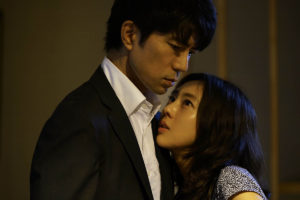
The festival kicks off with Opening Film Love Looming, the newest from jury chair Kunitoshi Manda, marking the first time he’s directed Toru Nakamura since 2007’s The Kiss, and the first time indie actor-producer Kiki Sugino has been reunited onscreen with megastar Takumi Saitoh since she directed him in 2014’s Taksu.
Nakamura plays Takashi, a widowed psychologist who runs a mental clinic and one day begins treating a new patient, Ayako (Sugino), for anxiety and insomnia. The doctor stays at work late nearly every night not only to avoid his son, who reminds him so much of his beloved wife, Kaoru, but also to commune with the dead. He’s been widowed for 6 years but has not recovered from the shock of Kaoru’s death. His overwhelming loneliness is something he shares with the orphaned Ayako, who soon successfully seduces him.
But nothing is quite as it seems in the mysteriously hermetic world of this beautifully shot film, and when Takashi’s former brother-in-law Shigeru (Saitoh) shows up to warn him away from his new paramour, the ensuing secrets and lies gradually threaten to overwhelm all of them.
Competition Films
The 12-film Competition section features some of this year’s most buzzed-about Asian titles from other festivals, including the Cannes Premiere 2020-labeled Should the Wind Drop by Nora Martirosyan, the Venice Competition title In Between Dying by Hilal Baydarov, Ko Chen-Nien’s Taipei Film Festival opener The Silent Forest and Aly Ayn Arumpac’s Aswang, which premiered at the Amsterdam International Documentary Film Festival.
There are four Japanese films in the FILMeX Competition as well, including The Blue Danube, the fourth feature from Akira Ikeda, whose 2013 Anatomy of a Paper Clip was a revelation. We're looking forward to seeing that one as well as Yoju Matsubayashi’s Okinawa Santos, his first documentary since 2013’s The Horses of Fukushima.
The other two are certified must-sees:
 A Balance
Japan / 2020 / 152 min.
Director: Yujiro Harumoto
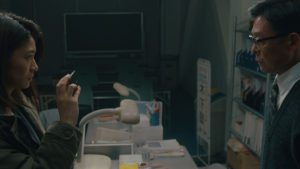
Yujiro Harumoto’s sophomore feature is even more remarkable than his acclaimed debut, Going the Distance (2016), and has already started stocking up on overseas accolades (like a Jury Award from the Pingyao International Film Festival in mid-October, with many more sure to come).
TV documentary director Yuko (Kumi Takiuchi) is working on a story about a case of high-school bullying that led to two suicides, when one of her young cram-school students falls ill. Yuko’s father, Masashi (Ken Mitsuishi), is the school’s owner, and the two make a great team as they juggle classes, discuss student problems and lament their dwindling cash flow.
As Yuko edits her interviews and struggles with just how much to implicate the press in the bullying case — the media are clearly in the wrong, but her producer is being forced to place the blame elsewhere — she begins helping the ill student, Mei (Yumi Kawai), whose widowed father is struggling to make ends meet.
But then Mei reveals a shocking secret, and Yuko is suddenly forced to see her bullying story from another, more personal, side. This upends her life, with ramifications that expand ever outward. Completely unsentimental and utterly unforgettable, A Balance patiently peels back the onion of what Screen Daily’s review termed “Japan’s culture of shame, which spreads like a stain through the lives of anyone touched by rumor or wrongdoing.”
 Any Crybabies Around?
Japan / 2020 / 108 min.
Director: Takuma Sato
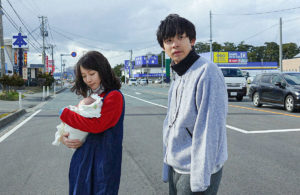
Takuma Sato’s commercial debut has already snagged a Best Cinematography Award at the 2020 San Sebastian Film Festival, where it had its world premiere. Its rather exotic backdrop — the remote Oga Peninsula in far-north Akita Prefecture, home of the famed New Year’s Eve ritual of Namahage, in which men in ferocious ogre costumes try to scare kids away from doing bad things for the next year — as well as its “developed by Hirokazu Kore-eda” label, is sure to propel it to even greater recognition.
The always-excellent Taiga Nakano plays Tasuku, who has been ostracized for demeaning the village’s Namahage by getting drunk and staggering around during a national TV broadcast, flees to Tokyo for a few years. But he has “no money, no job, no confidence, nothing,” and when he hears that his ex-wife Kotoke (Riho Yoshioka) is in trouble, he decides to return to his hometown to help her out, as well as to redeem himself with his daughter. But rebuilding bonds is much more difficult than he’d imagined.
Special Screenings
 Minamata Mandala
Japan / 2020 / 369 min.
Director: Kazuo Hara
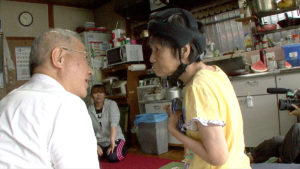
FILMeX will be hosting one special screening of Kazuo Hara’s latest masterpiece of closely-observed illness, death, despair, government indifference and victim outrage, Minamata Mandala, and it’s likely to be your only chance to see the subbed version until next year’s Yamagata Documentary Festival.
Hara (The Emperor's Naked Army Marches On, Sennan Asbestos Disaster, Reiwa Uprising) spent nearly 2 decades working on this documentary about Japan’s most infamous chemical pollution case, shooting for 15 years and editing for another 3. The result is an epic that, like his Sennan Asbestos Disaster, follows the victims of an environmental disaster, their families and their supporters, as a lawsuit wends its way through Japan’s labyrinthine court system.
In 1932, the Chisso company had begun producing acetaldehyde in its plant next to Minamata Bay, Fukuoka. It wasn’t until 1956 that the first cases of neurological damage caused by methyl mercury runoff were identified among residents and earned the appellation Minamata Disease. It wasn’t until many more years, a mounting victim count and the poisoning of fish and shellfish in the bay, that the government began to take the polluting seriously. As the Hong Kong International Film Festival said about the film: “Hara probes the lingering pain of this industrial crime and government failure, forcing us to watch at length [in] horror the life of Minamata’s citizens, from birth to death.”
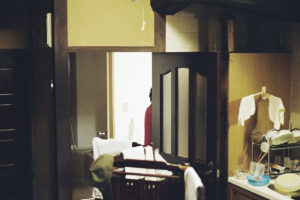 The Work and Days (in the Shiotani Basin)
USA, Sweden, Japan, UK / 2020 / 480 min.
Director: C.W. Winter, Anders Edstrom
Another extremely lengthy Japanese-language film that will receive a special screening at FILMeX is this 8-hour docu-style narrative ranging over 14 months in the life of Tayoko Shiojiri, her family, friends and neighbors, all farmers living in a tiny hamlet in the Kyoto mountains. Shiojiri is actually co-director Edstrom’s mother-in-law, and the husband whose health worsens as the months go on, his father-in-law. In the diary she keeps, which serves as the film’s narration, Tayoko looks back and reflects, as death pulls its shroud around the Shiotani Basin.
The gorgeous landscape imagery, the dense soundscape and the scenes of day-to-day labor and camaraderie, as well as the occasional familiar face — star Ryo Kase appears as one of the characters — are absolutely mesmerizing. Winner of the Best Film Prize in the Encounters section of the 2020 Berlin International Film Festival, it marks the directors’ second feature-length collaboration since The Anchorage, a decade ago. One hopes their next will arrive sooner.
Yurakucho Asahi Hall, Yurakucho Subaruza
Title: 東京フィルメックス 2020 ( TOKYO FILMeX 2020)
Venue: Human Trust Cinema Yurakucho, Toho Cinema Chanter, Yurakucho Asahi Hall
Oct. 30 (Fri) – Nov. 7 (Sat), 2020
Details: filmex.jp/2020en/schedule
Official website: filmex.net/2020en/
Theater website: filmex.jp/2020/map
Tariff: General: ¥1,900, Under 25 years old: ¥1,300. Go to
Tokyo FILMeX has shifted its dates back to coincide with the Tokyo International Film Festival’s, as part of a newly announced collaborative arrangement that it likens to the relationship between the Cannes Film Festival and its famed sidebars like Cannes Critic’s Week or Cannes Director’s Fortnight. But never fear, the festival hasn’t otherwise changed. Like TIFF, FILMeX will be marking its 21st edition physically, and it will feature its usual carefully-curated lineup of eagerly anticipated arthouse treats from around the world.
The longtime local favorite of cinephiles, FILMeX will run for nine days, from October 30 - November 8, at its home base in Yurakucho Asahi Hall, with expanded screenings at Toho Chanter and late shows of select titles rerun in the nearby Yurakucho Human Trust. All but one film (the closing title by Israeli auteur Elia Suleiman, who is this year’s Filmmaker in Focus) sport English subtitles.
Festival director Shozo Ichiyama, a co-founder of FILMeX and producer of countless acclaimed arthouse titles in his own right, continues to oversee the overall selection. This year’s jury of five is comprised of Japan-based aficionados only (thanks to the pandemic), including Tokyo Filmgoer friends Tom Mes, critic, educator and founder of Midnight Eye; Eric Nyari, producer and international rep for famed New York restoration house Cineric; and critic and educator Chris Fujiwara. With jury chair Kunitoshi Manda and programmer Abi Sakamoto, they will be handing out the festival’s Grand Prize (¥1 million) and the Special Jury Prize (¥500,000). There is also an Audience Award chosen from among all sections, and the Student Jury Prize.
Opening Film: Love Looming
Love Looming
Japan / 2020 / 102 min.
Director: Kunitoshi Manda
The festival kicks off with Opening Film Love Looming, the newest from jury chair Kunitoshi Manda, marking the first time he’s directed Toru Nakamura since 2007’s The Kiss, and the first time indie actor-producer Kiki Sugino has been reunited onscreen with megastar Takumi Saitoh since she directed him in 2014’s Taksu.
Nakamura plays Takashi, a widowed psychologist who runs a mental clinic and one day begins treating a new patient, Ayako (Sugino), for anxiety and insomnia. The doctor stays at work late nearly every night not only to avoid his son, who reminds him so much of his beloved wife, Kaoru, but also to commune with the dead. He’s been widowed for 6 years but has not recovered from the shock of Kaoru’s death. His overwhelming loneliness is something he shares with the orphaned Ayako, who soon successfully seduces him.
But nothing is quite as it seems in the mysteriously hermetic world of this beautifully shot film, and when Takashi’s former brother-in-law Shigeru (Saitoh) shows up to warn him away from his new paramour, the ensuing secrets and lies gradually threaten to overwhelm all of them.
Competition Films
The 12-film Competition section features some of this year’s most buzzed-about Asian titles from other festivals, including the Cannes Premiere 2020-labeled Should the Wind Drop by Nora Martirosyan, the Venice Competition title In Between Dying by Hilal Baydarov, Ko Chen-Nien’s Taipei Film Festival opener The Silent Forest and Aly Ayn Arumpac’s Aswang, which premiered at the Amsterdam International Documentary Film Festival.
There are four Japanese films in the FILMeX Competition as well, including The Blue Danube, the fourth feature from Akira Ikeda, whose 2013 Anatomy of a Paper Clip was a revelation. We're looking forward to seeing that one as well as Yoju Matsubayashi’s Okinawa Santos, his first documentary since 2013’s The Horses of Fukushima.
The other two are certified must-sees:
A Balance
Japan / 2020 / 152 min.
Director: Yujiro Harumoto
Yujiro Harumoto’s sophomore feature is even more remarkable than his acclaimed debut, Going the Distance (2016), and has already started stocking up on overseas accolades (like a Jury Award from the Pingyao International Film Festival in mid-October, with many more sure to come).
TV documentary director Yuko (Kumi Takiuchi) is working on a story about a case of high-school bullying that led to two suicides, when one of her young cram-school students falls ill. Yuko’s father, Masashi (Ken Mitsuishi), is the school’s owner, and the two make a great team as they juggle classes, discuss student problems and lament their dwindling cash flow.
As Yuko edits her interviews and struggles with just how much to implicate the press in the bullying case — the media are clearly in the wrong, but her producer is being forced to place the blame elsewhere — she begins helping the ill student, Mei (Yumi Kawai), whose widowed father is struggling to make ends meet.
But then Mei reveals a shocking secret, and Yuko is suddenly forced to see her bullying story from another, more personal, side. This upends her life, with ramifications that expand ever outward. Completely unsentimental and utterly unforgettable, A Balance patiently peels back the onion of what Screen Daily’s review termed “Japan’s culture of shame, which spreads like a stain through the lives of anyone touched by rumor or wrongdoing.”
Any Crybabies Around?
Japan / 2020 / 108 min.
Director: Takuma Sato
Takuma Sato’s commercial debut has already snagged a Best Cinematography Award at the 2020 San Sebastian Film Festival, where it had its world premiere. Its rather exotic backdrop — the remote Oga Peninsula in far-north Akita Prefecture, home of the famed New Year’s Eve ritual of Namahage, in which men in ferocious ogre costumes try to scare kids away from doing bad things for the next year — as well as its “developed by Hirokazu Kore-eda” label, is sure to propel it to even greater recognition.
The always-excellent Taiga Nakano plays Tasuku, who has been ostracized for demeaning the village’s Namahage by getting drunk and staggering around during a national TV broadcast, flees to Tokyo for a few years. But he has “no money, no job, no confidence, nothing,” and when he hears that his ex-wife Kotoke (Riho Yoshioka) is in trouble, he decides to return to his hometown to help her out, as well as to redeem himself with his daughter. But rebuilding bonds is much more difficult than he’d imagined.
Special Screenings
Minamata Mandala
Japan / 2020 / 369 min.
Director: Kazuo Hara
FILMeX will be hosting one special screening of Kazuo Hara’s latest masterpiece of closely-observed illness, death, despair, government indifference and victim outrage, Minamata Mandala, and it’s likely to be your only chance to see the subbed version until next year’s Yamagata Documentary Festival.
Hara (The Emperor's Naked Army Marches On, Sennan Asbestos Disaster, Reiwa Uprising) spent nearly 2 decades working on this documentary about Japan’s most infamous chemical pollution case, shooting for 15 years and editing for another 3. The result is an epic that, like his Sennan Asbestos Disaster, follows the victims of an environmental disaster, their families and their supporters, as a lawsuit wends its way through Japan’s labyrinthine court system.
In 1932, the Chisso company had begun producing acetaldehyde in its plant next to Minamata Bay, Fukuoka. It wasn’t until 1956 that the first cases of neurological damage caused by methyl mercury runoff were identified among residents and earned the appellation Minamata Disease. It wasn’t until many more years, a mounting victim count and the poisoning of fish and shellfish in the bay, that the government began to take the polluting seriously. As the Hong Kong International Film Festival said about the film: “Hara probes the lingering pain of this industrial crime and government failure, forcing us to watch at length [in] horror the life of Minamata’s citizens, from birth to death.”
The Work and Days (in the Shiotani Basin)
USA, Sweden, Japan, UK / 2020 / 480 min.
Director: C.W. Winter, Anders Edstrom
Another extremely lengthy Japanese-language film that will receive a special screening at FILMeX is this 8-hour docu-style narrative ranging over 14 months in the life of Tayoko Shiojiri, her family, friends and neighbors, all farmers living in a tiny hamlet in the Kyoto mountains. Shiojiri is actually co-director Edstrom’s mother-in-law, and the husband whose health worsens as the months go on, his father-in-law. In the diary she keeps, which serves as the film’s narration, Tayoko looks back and reflects, as death pulls its shroud around the Shiotani Basin.
The gorgeous landscape imagery, the dense soundscape and the scenes of day-to-day labor and camaraderie, as well as the occasional familiar face — star Ryo Kase appears as one of the characters — are absolutely mesmerizing. Winner of the Best Film Prize in the Encounters section of the 2020 Berlin International Film Festival, it marks the directors’ second feature-length collaboration since The Anchorage, a decade ago. One hopes their next will arrive sooner.
Yurakucho Asahi Hall, Yurakucho Subaruza
Title: 東京フィルメックス 2020 ( TOKYO FILMeX 2020)
Venue: Human Trust Cinema Yurakucho, Toho Cinema Chanter, Yurakucho Asahi Hall
Oct. 30 (Fri) – Nov. 7 (Sat), 2020
Details: filmex.jp/2020en/schedule
Official website: filmex.net/2020en/
Theater website: filmex.jp/2020/map
Tariff: General: ¥1,900, Under 25 years old: ¥1,300. Go to
Please be sure to check with the theater before going.